Night Duel Over Germany: Bomber Command's Battle Over the Reich During WWII by Peter Jacobs
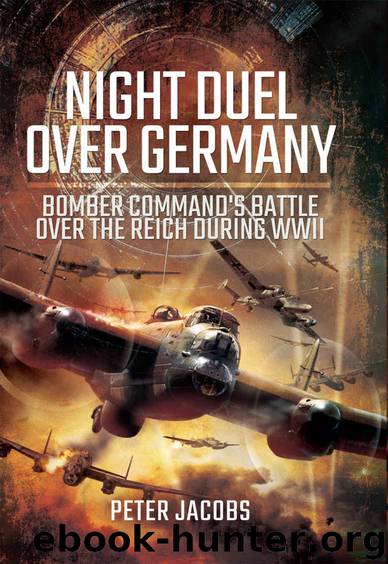
Author:Peter Jacobs [Jacobs, Peter]
Language: eng
Format: azw3
Publisher: Pen and Sword
Published: 2017-01-30T05:00:00+00:00
Chapter Twelve
More Precision Required
Ask anyone if he remembers his first bombing operation – he will. It’s a kind of high adventure one never forgets. Even the smallest detail stays fresh in the mind long after most other operational flights have slipped away into memories limbo.
The words belong to Arthur Orchard who later recalled his first op on the night of 17/18 August 1943 when Bomber Command launched Operation Hydra against the German V-weapons research establishment at Peenemünde on the Baltic coast. With growing evidence the Germans were building and testing new V-rockets at the site, the destruction of the facility had become one of the War Cabinet’s highest priorities.
Harris had initially delayed the raid until conditions were favourable for his attacking force. The moon period had offered some welcome respite for his squadrons but now was the time, and so he ordered the attack. The plan put in place was one of Bomber Command’s most complex yet. The precision attack against this small target was to be carried out at night, the aim being to hit specific buildings rather than to bomb the whole area. To make marking and bombing easier the raid was to take place under bright moonlit conditions and, to further increase the chances of success, it would involve a Master Bomber to control the attack.
This was the first time the Master Bomber concept was to be used for a large-scale attack and the man chosen for the task was 30-year-old Group Captain John Searby, the commanding officer of 83 Squadron. He would direct the large attacking force of nearly 600 bombers – a mix of Lancasters, Halifaxes and Stirlings – with three main aiming points specified: the factory, the experimental testing site and the living accommodation.
For one young Lancaster crew of 101 Squadron based at Ludford Magna up in the Lincolnshire Wolds, Peenemünde was to be their first op. At twenty-six, Flight Sergeant Fred Ray was the oldest of his crew. The rest were all under the age of twenty-one and included 20-year-old Sergeant Arthur Orchard, the rear gunner and a former employee of the Vauxhall Motor Company in his home town of Luton. Orchard later recalled his feelings that night:
The first op is a long awaited consummation of hundreds of hours of flying training between seven young men. That afternoon the station was buzzing with pre-ops gossip. Since the petrol load was a relatively large one we knew it was going to be a long trip, but we hadn’t the least idea where. Not till briefing time did we know and the news was not conducive to the morale of a sprog crew. The target was Peenemünde, a long way on the German Baltic coast. Our intelligence had discovered their highly secret research and development complex. We were told they wouldn’t be expecting us and so this could be a once only attack and had to be effective. But that night was chosen particularly because it was a full moon. We gasped. We would be seen by every German night fighter between the Channel and the Baltic.
Download
This site does not store any files on its server. We only index and link to content provided by other sites. Please contact the content providers to delete copyright contents if any and email us, we'll remove relevant links or contents immediately.
| Africa | Americas |
| Arctic & Antarctica | Asia |
| Australia & Oceania | Europe |
| Middle East | Russia |
| United States | World |
| Ancient Civilizations | Military |
| Historical Study & Educational Resources |
The Radium Girls by Kate Moore(12093)
100 Deadly Skills by Clint Emerson(4972)
Rise and Kill First by Ronen Bergman(4838)
The Templars by Dan Jones(4732)
The Doomsday Machine by Daniel Ellsberg(4545)
The Rape of Nanking by Iris Chang(4255)
Killing England by Bill O'Reilly(4042)
Stalin by Stephen Kotkin(4004)
Hitler in Los Angeles by Steven J. Ross(3978)
12 Strong by Doug Stanton(3575)
Hitler's Monsters by Eric Kurlander(3384)
The Code Book by Simon Singh(3250)
Blood and Sand by Alex Von Tunzelmann(3240)
Darkest Hour by Anthony McCarten(3161)
The Art of War Visualized by Jessica Hagy(3043)
Hitler's Flying Saucers: A Guide to German Flying Discs of the Second World War by Stevens Henry(2777)
Babylon's Ark by Lawrence Anthony(2718)
Tobruk by Peter Fitzsimons(2559)
The Second World Wars by Victor Davis Hanson(2554)
